In January 2025, the British Standards Institution (BSI) published BS 8674:2025, a new fire safety standard that defines a clear competency framework for fire risk assessors in the UK.
For the first time, fire risk assessors have a nationally recognised benchmark to measure competence, giving businesses confidence that assessments are carried out to a consistent and professional standard.

Blog Overview: How BS 8674:2025 is Changing the Fire Safety Industry
The new BS 8674:2025 sets clear requirements for fire risk assessors, ensuring a consistently competent level of fire risk assessments across the UK.
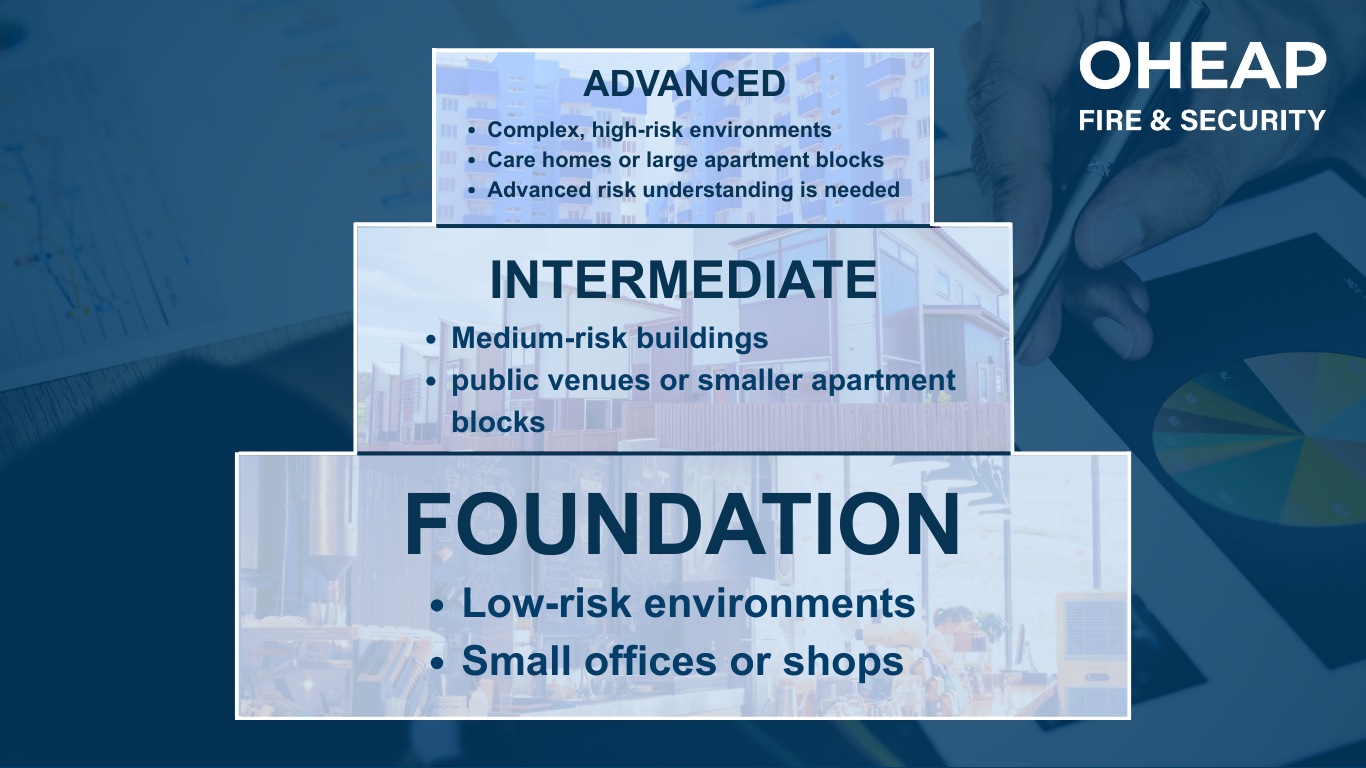
The standard introduces three levels of fire risk assessor competency: foundation, intermediate and advanced. These help businesses identify the right level of expertise for their needs.
Developed in response to the 2017 Grenfell Tower tragedy, BS 8674:2025 strengthens regulation and raises the bar for fire safety.
The new framework achieves three key things:
- Builds businesses’ trust in their building’s fire safety.
- Supports the development of fire risk assessor skills.
- Ensures maximum fire safety and compliance.
What is BS 8674:2025?
BS 8674:2025 was developed in response to the 2017 Grenfell Tower tragedy, which exposed the devastating consequences of inconsistent and inadequate fire risk assessments.
Following the national inquiry, the final report (published in September 2024) recommended the creation of a formal competency framework. BS 8674:2025 is the result, offering performance-based criteria and three clear competency levels:
- Foundation – for assessors handling lower-risk buildings.
- Intermediate – for moderate-risk environments.
- Advanced – for complex and high-risk sites.
Who Does the BS 8674:2025 Affect?
While BS 8674:2025 primarily affects fire risk assessors, it also impacts:
- The Responsible Person under the Regulatory Reform (Fire Safety) Order 2005 and Building Safety Act 2022.
- Certification and accreditation bodies assessing individuals against competency benchmarks.
- Training providers and academic institutions designing assessor qualifications.
- Employers, duty holders and property managers seeking assurance of fire risk assessment compliance.
- Professional bodies and trade associations aligning with industry standards.
What Impact Will BS 8674:2025 Have on the Fire Safety Industry?
BS 8674:2025 will create more consistency and professionalism across the fire safety industry. Property owners and businesses will also gain greater confidence in the skill set of the assessor.
BS 8674:2025 also provides a career pathway for fire risk assessors, helping them identify their current level of competence and what skills they need to progress further. While some may attempt to avoid these requirements, the framework sets a clear national benchmark that raises the overall standard of fire safety in the UK.
How Does BS 8674:2025 Affect Fire Risk Assessments?
The BS 8674:2025 does not directly affect how fire risk assessments are carried out.
Instead, BS 8674:2025 impacts fire risk assessors themselves by providing a competency framework that defines the knowledge and skills required at each level.
Ultimately, this will have a knock-on effect on the reliability and trust businesses can place in their fire risk assessment reports.
How Will the BS 8674:2025 Benefit Businesses?
BS 8674:2025 benefits businesses by:
- Building confidence in the quality of fire risk assessment reports.
- Assuring that assessors meet the right competency level for the building type.
- Supporting stronger compliance with UK fire safety law.
At OHEAP, we already work exclusively with nationally accredited fire risk assessors, ensuring every assessment meets the highest standards.
How Will BS 8674:2025 Affect OHEAP?
BS 8674:2025 aligns perfectly with the way OHEAP already operate. We have always partnered exclusively with nationally accredited fire risk assessors, ensuring every assessment meets the highest professional standards.
Organisations such as the Institute of Fire Safety Managers (IFSM) and the Institute of Fire Engineers (IFE) have long applied tiered competency models. OHEAP continues to work with assessors who meet these rigorous benchmarks, giving our customers full confidence that our fire risk assessments are compliant with BS 8674:2025.
Are you a qualified Fire Risk Assessor looking for your next career move?
OHEAP are currently building our team of trusted fire safety experts. If you are curious to find out more, head to our fire risk assessment page to contact us today.